AI Product Innovation
From ambiguous problem to product concept, prototype, business case and pitch.
This case study is about creating a product from an ambiguous problem, not running an existing one. It follows DeviceFlex, which I conceived, designed and built solo for AT&T’s Sprint-a-thon 2026, now backed by an invention disclosure submitted to AT&T’s patent program.
The same method sits behind AT&T Helios, which won Best in Show / All Around at the 2026 Innovation Jam, and behind two hackathon wins in 2025.
- Role
- Product lead and sole builder (DeviceFlex)
- Event
- AT&T Sprint-a-thon 2026
- Built
- 19 Aug – 5 Sep 2026 · 100 commits
- Status
- Working prototype · invention disclosure submitted
- Stack
- TanStack Start · React 19 · TypeScript · Zod · vision model
- Track record
- Innovation Jam 2026 · AT&T Hackathon 2025 · Equitech 2025
- Inventive mechanisms, all running in the prototype
- 5
- Product routes, end to end
- 17
- From first commit to the demo build
- 17 days
- Innovation Jam Best in Show / All Around
- 2026
Contents
The method
I use the same sequence whether the brief is a hackathon prompt or an internal opportunity. The order matters: the insight comes before the concept, and the prototype comes before the pitch.
- 01ProblemWhere it breaksFor whom, and at which moment
- 02InsightThe unfair advantageWhat we hold that others cannot
- 03ConceptSmallest productThat puts the insight to work
- 04PrototypeClickable and honestReal where it counts, labelled where not
- 05CaseBusiness caseLevers, risks, a phased roadmap
- 06PitchStory and IPThe mechanism worth protecting
- 2026
- DeviceFlex · AT&T Sprint-a-thon · invention disclosure submitted (this case study)
- 2026
- AT&T Helios: Zero Friction Convergence · AT&T Innovation Jam · Best in Show / All Around
- 2025
- Hyper-personalized international travel · AT&T Hackathon · 1st Place
- 2025
- Equitech Hackathon · Most Impactful Business Solution
Problem
Device protection is the one product customers pay for every month and hope never to use. Carriers resell substantially the same insurer-administered product on substantially the same terms, so it competes on price. Competing on experience has barely been tried.
Where it breaks, from the member’s side:
- The deductible is a surprise. The most important number in the product is the one customers learn last, at the counter or midway through a claim.
- Loss claims run on trust alone. An administrator that doesn’t operate a network can’t check whether a phone really went dark. It believes the customer or asks for an affidavit.
- Coverage is bound to a handset. The policy names a device, and the backup belongs to whichever cloud account the customer set up months earlier.
- Nothing happens between claims. There is no reason to open the product in the months when nothing breaks.
Insight
The carrier already holds evidence no insurer can see.
AT&T runs the network. For every line it already knows when a device last reached a tower, whether it went dark abruptly or wound down, and whether the SIM has since appeared in a different handset. An administrator without a network has no equivalent and no path to one.
That is a structural advantage, not a head start, and it reframes the product: a claim can be corroborated by the network instead of taken on trust.
Concept
DeviceFlex turns protection into a membership that does something every month, and rebuilds the claim around signals only the operator holds. It is not a competing product: it layers onto the protection program AT&T already runs, inside the existing myAT&T experience, with no separate app and no new brand.
- A tiered membership (Basic, Plus, Family) offered at the add-ons step of a normal purchase, with deductibles visible before a plan is chosen.
- A household Protection Score that sets fraud-review sensitivity, inspection needs and whether a spare is pre-positioned.
- A Data Vault, so data continuity is guaranteed even when a spare handset isn’t.
Product vision
Know the cost first
The deductible and the resolution are visible before you commit.
Let the network back your story
Carrier signals corroborate loss and theft, so honest members move faster.
Your data follows your number
Coverage and restore are keyed to the line, not the handset.
Three audiences benefit. Covered households know the cost and the outcome before committing. Store associates and technicians receive a claim that is already verified, priced and routed to a store with stock. The insurer and its underwriter receive a complete, corroborated, auditable claim instead of an affidavit and a phone call.
User journey
- 01DiscoverProtection appears as a tiered membership at the add-ons step of a normal purchase, with deductibles shown before a plan is chosen.
- 02EnrolTwo doors: the 30-day new-device window or open enrollment. Every device presents a verified condition check before coverage starts.
- 03Live with itA household Protection Score drives fraud sensitivity, inspection needs and pre-positioned spares.
- 04ClaimPhotos for damage, an incident report for loss or theft, diagnostics for malfunctions. Six checks run in view.
- 05ConsentSuspending a line and blocklisting a device is a separate, explicit step, refused outright when the network contradicts the report.
- 06ResolveAn advisor ranks repair, home repair, swap, ship and upgrade on cost, time and data.
- 07RestoreThe replacement is provisioned from the line's manifest. The broken device takes part in nothing.
AI opportunity
AI perceives. Deterministic functions decide.
The obvious design wires a vision model’s confidence straight into approve or deny. DeviceFlex does the opposite. Models are confined to perception: turning messy input, like a photo of a cracked screen or a disconnection pattern, into structured facts. Every consequential decision (approve, price, route, blocklist) is made by a pure, replayable function over those facts and the account state.
That split is the governance model. A model cannot approve, deny or price anything; it can only describe what it observed. The constraint is architectural rather than procedural, so it holds under pressure and can be demonstrated instead of attested.
Perception
Probabilistic
Messy input to structured facts: vision model, LLM, anomaly detection.
severity: moderate · confidence: 0.82
Decision
Pure function, replayable
Structured facts to a verdict and a resolution. Same input, same output, recorded with digests.
approve → home repair → $0
Architecture
The same insurer sits at the end of the path. DeviceFlex changes what reaches its intake, not who receives it.
- 1Source systemsInputs
- Handset camera
- Claim intake
- On-device inspection
- Carrier network
- Account and billing
- 2PerceptionProbabilistic
- Damage assessment
- Disconnect analysis
- Coverage assistant
- 3Fact contractSchema-validated
- Enumerated severity
- Boolean flags
- Integer scores
- Timestamps
- Digests
- 4Decision enginePure functions
- Claim corroboration
- Underwriting gate
- Resolution optimizer
- Protection posture
- 5LedgerReplayable
- Input digest
- Output digest
- Replay
- 6EffectsActions
- Insurer intake
- Blocklist and suspension, with consent
- Fulfilment pre-staging
- Line-anchored provisioning
- 1Source systems. Carrier network and account data are inputs only an operator holds.
- 2Perception. Models turn messy input into structured facts, and nothing else.
- 3Fact contract. Model output is validated at the boundary; a malformed response falls back to the deterministic path.
- 4Decision engine. Every verdict is a pure function of facts and account state, with time passed in rather than read from the clock.
- 5Ledger. Each decision is recorded with digests of its input and output, so it can be re-run and compared.
- 6Effects. One payload shape reaches the insurer, whatever the claim type.
Five mechanisms
The protectable core is the mechanism, not the membership. Pricing tiers are an economic practice; these are technical improvements to how the system works.
- 01Network-corroborated claimsCarrier telemetry (last seen on network, disconnection pattern, SIM and device status) corroborates or contradicts a loss or theft report before a person reviews it.
- 02Line-anchored restoreCoverage and a restore manifest are keyed to the subscriber line, with handsets as pointers, so a replacement is provisioned from the line.
- 03Replayable decision ledgerEvery automated decision can be re-executed from its recorded input and verified against its recorded output.
- 04Pre-staging optimizerA device-health index that, past a threshold, pre-positions a matching replacement at the nearest capable store.
- 05Attested enrolmentEnrolment requires a recent, verified condition attestation from the device, enforced where state changes rather than in the interface.
Key decisions
ACut the loaner phone and gadget library
WhyA loaner's availability can't be guaranteed, and a product shouldn't promise what it can't control. The Data Vault guarantees data continuity instead.
Trade-off managedA perk that sounds good went away; the concept got tighter and more defensible.
BRefuse to blocklist on disputed evidence
WhyA blocklisted device stops working on every US carrier. When the network contradicts a report, the claim goes to a specialist instead.
Trade-off managedSlower resolution for contradicted claims, in exchange for never stranding a working device.
CDegrade to deterministic, never to a spinner
WhyEvery dependency has a defined fallback: no vision model means the on-device assessment; no telemetry means "inconclusive", never a fabricated pass.
Trade-off managedLower-fidelity answers during outages, stated plainly in the interface.
DEnforce gates where state changes, not in the UI
WhyA control a screen can route around is only a suggestion, so enrolment without a valid attestation is dropped in the state layer.
Trade-off managedMore discipline in the core, less room for quick interface workarounds.
ELabel what is real, seeded and absent
WhyA prototype that overstates itself is worse than one that admits its edges.
Trade-off managedA less magical demo, and a more credible one.
Business value
The levers, without internal figures:
- Attach. Answering the deductible question up front narrows the gap between online and in-store attach.
- Revenue per account. A tier ladder, with the Family tier growing revenue per household faster than per device.
- Claims cost. Network corroboration gates loss and theft fraud before a person reviews it.
- Replacement time. Pre-staging and line-anchored provisioning are designed for a roughly 15-minute in-store swap instead of a shipped replacement.
- Retention. A shared household pool and vault create switching costs.
- Cost to serve. Inference scales with claims, not traffic: dashboards, scores and eligibility checks are pure functions over state the system already holds.
Prototype and demo
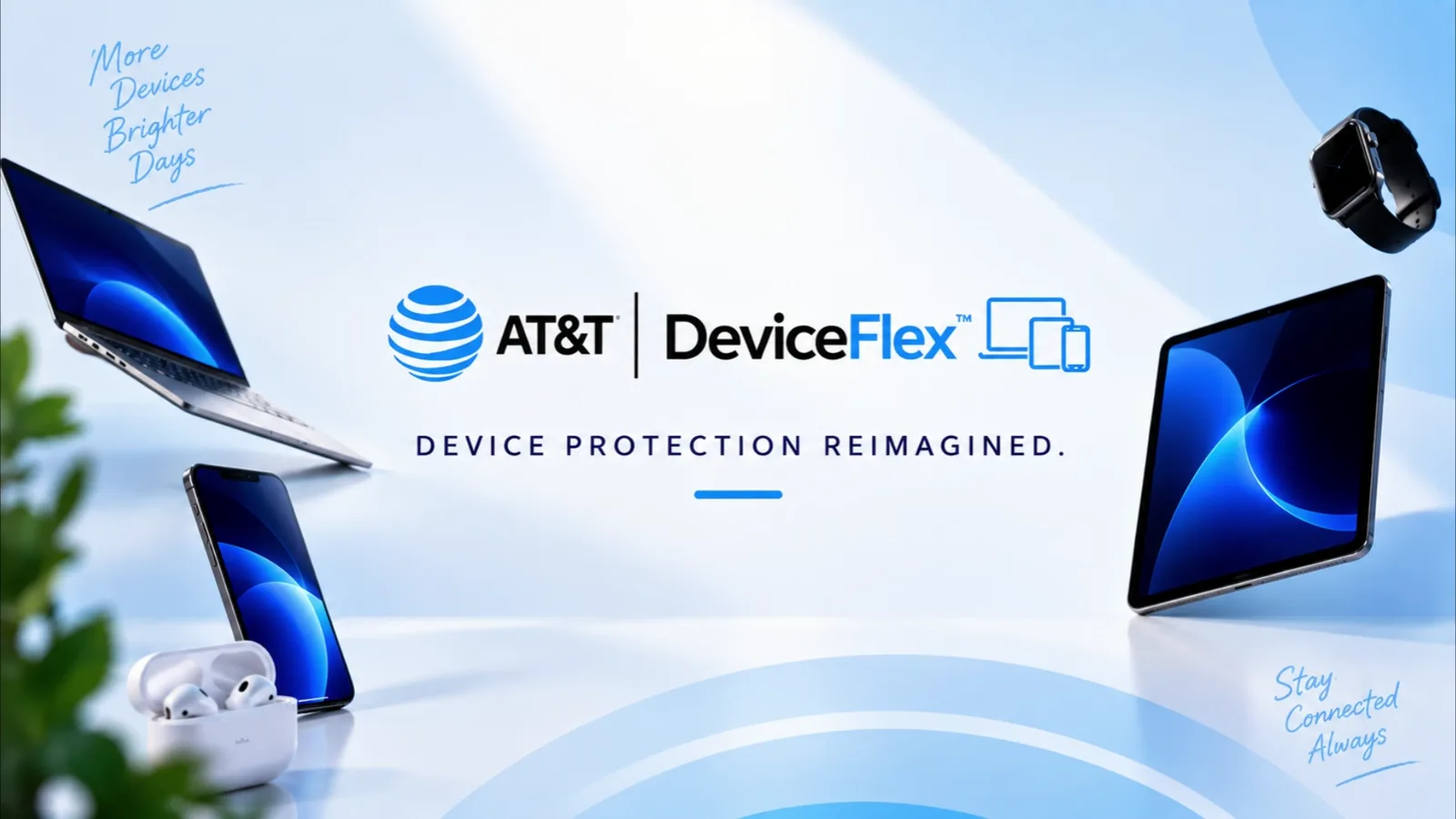
A working, deployed prototype, built solo between 19 August and 5 September 2026: 17 routes covering the purchase flow, enrolment, claims, replacement, the vault, the household pool, and an impact screen where any decision can be replayed live. All five mechanisms run in it. The interface mirrors the existing myAT&T experience because the product is designed to live inside it.
What is real, seeded and absent
- Real
- The full journey across every route; the vision-model call with schema validation and fallback; the decision ledger with verified replay; the consent gate; the attestation gate in the state layer.
- Seeded
- Carrier telemetry for eight demo devices, one of which deliberately contradicts its loss report; fixed store inventory so answers are reproducible.
- Stand-in
- Signatures and tokens are digests over canonical JSON, not credentials. A deployment would sign in the device secure element and a hardware security module.
- Absent
- Payment and real authentication, deliberately.
DeviceFlex source on GitHub (opens in a new tab)TanStack Start · React 19 · TypeScript · Tailwind · Zod · OpenAI-compatible vision model
Why it can scale
- No acquisition problem. The audience is already inside myAT&T.
- An evidence-first rollout. Deductible transparency ships first as a standalone change. Network corroboration then runs in shadow mode, logged but not enforced, until its agreement with manual review is proven.
- A platform, not a feature. Corroboration and attestation are general capabilities that fraud, care and retail teams can all use.
- A portable build. The same build targets Vercel, Cloudflare Workers or Node, and the vision provider is three environment variables.
- 01NowPrototypeFive mechanisms deployed; invention disclosure submitted
- 020–3 monthsDeductible transparencyShipped into the live claim flow on its own
- 033–6 monthsShadow-mode corroborationDecisions logged, not enforced
- 046–9 monthsLine manifest and attestationOne device family first
- 059–15 monthsPre-staging pilotOne metro; tiers replace the flat charge
Honest risks. Rules on customer network data (CPNI) are the long pole, and shadow mode exists to build that case with evidence. Corroboration can be wrong, because a phone in a drawer looks like a lost phone, which is why the system flags rather than refuses. Pre-staging ties up inventory, so the threshold starts conservative.
Other innovation work
AT&T Helios: Zero Friction Convergence
AT&T Innovation Jam 2026 · Best in Show / All Around
Buying a converged bundle of mobile, fiber and accessories meant navigating several disconnected flows, with trade-in, bring-your-own-device and eligibility checks each in their own silo. Helios proposed an AI-fueled single cart that assembles devices, plans, fiber and trade-in in one guided flow, with real-time eligibility and bundle recommendations inline.
Hyper-personalized international travel
AT&T Hackathon 2025 · 1st Place
International roaming activation was confusing and reactive: customers found the right plan too late, which meant bill shock and support contacts. The concept used predictive models over travel patterns and media preferences to recommend the right plan in advance, with plan comparison, coverage checks and self-serve troubleshooting.
Equitech Hackathon
2025 · Most Impactful Business Solution
Recognized as the most impactful business solution of the event.
What I learned
- Protect the mechanism, not the business model. A tiered membership is an economic practice anyone can copy. Network corroboration, line-anchored restore and a replayable ledger are technical, and hard to replicate without a network.
- Cutting a feature can strengthen a product. Removing the loaner made the promise smaller, fully deliverable and more defensible.
- A verifier that always agrees verifies nothing. The demo includes a device whose telemetry contradicts its loss report, because the system has to be seen disagreeing.
- Show the loop. A feedback loop nobody can see isn’t a demo, so the score’s effect on fraud sensitivity is visible in the interface.